
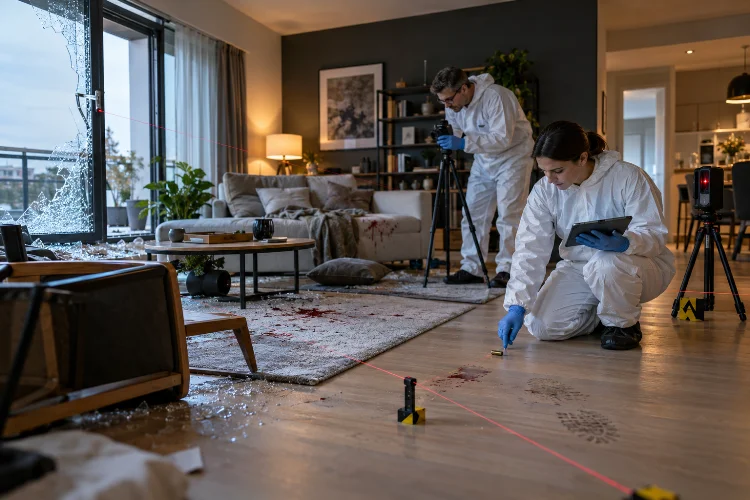
A crime scene rarely tells its story in a neat, chronological order. Investigators may find a broken window, several bloodstains, a cartridge case, damaged furniture, shoe impressions, and dozens of other details scattered around the scene.
The difficult part is not simply finding those clues. It is understanding how they relate to one another.
That is where advanced crime scene reconstruction becomes important.
Modern forensic reconstruction combines physical evidence, laboratory findings, spatial measurements, physics, statistics, and digital technology to develop scientifically supported explanations of what may have happened.
Instead of treating each clue as an isolated fact, investigators can build forensic evidence models that connect location, movement, timing, direction, and physical interaction.
This approach has become increasingly sophisticated as 3D laser scanners, photogrammetry, computer modeling, statistical analysis, and immersive visualization tools have entered forensic practice.
But advanced technology does not automatically produce the correct answer. The real value comes from combining accurate measurements with disciplined scientific reasoning, documented assumptions, and a clear understanding of uncertainty.
What Advanced Crime Scene Reconstruction Actually Means
Crime scene reconstruction is sometimes misunderstood as simply creating a visual animation of a crime. In reality, the process is much broader.
A reconstruction attempts to evaluate physical evidence and determine possible relationships between events.
Investigators may study where people or objects were located, how something moved, which event likely happened first, and whether a particular explanation is physically consistent with the evidence.
The American Academy of Forensic Sciences’ ANSI/ASB Standard 159 describes scene investigation and reconstruction as a process that should consider scientific reliability, preservation of context, evidence integrity, transparency, legal considerations, and bias management.
In other words, good reconstruction is not about creating the most convincing story. It is about developing explanations that remain consistent with the available evidence.
Consider a room containing several bloodstains, overturned furniture, a damaged wall, and a cartridge case.
None of these items alone explains what happened.
Their value grows when investigators examine their spatial and physical relationships. A blood pattern may suggest an area where an event occurred.
Damage to a wall may provide information about direction. Trace evidence may indicate contact between two surfaces. Digital measurements may reveal whether different evidence locations align with the same possible event.
Advanced recontruction brings these independent observations together within one structured model.
The important word here is model.
A forensic evidence model is not necessarily a single piece of software. It is a structured representation of evidence, measurements, relationships, assumptions, and possible event sequences.
Building a Forensic Evidence Model
A reliable forensic model usually begins with something surprisingly basic: separating what investigators actually observed from what they believe those observations mean.
Suppose an investigator finds an elongated bloodstain on a wall.
The stain’s location, dimensions, orientation, and physical characteristics are observations. Saying that the stain resulted from a specific action is an interpretation.
That distinction matters.
Research published through the National Institute of Justice has discussed the value of separating observation from interpretation in bloodstain pattern analysis.
The proposed approach encourages analysts to document measurable features first and only then consider possible mechanisms that could explain them. This can improve transparency and reduce the risk of conclusions influencing the initial description of evidence.
From Evidence Points to Relationships
The next step is connecting evidence spatially and physically.
A useful forensic evidence model may include scene geometry, object positions, biological evidence, impressions, firearm-related evidence, trace materials, damage patterns, laboratory results, and environmental conditions.
Investigators can then ask relational questions.
Does a suspected trajectory intersect a damaged surface?
Do several bloodstains indicate a similar region of origin?
Could an object realistically have moved from one position to another?
Do trace materials support contact between specific objects?
Does the physical evidence support the claimed sequence of events?
These questions transform a collection of evidence into a reconstruction framework.
The model can also contain multiple possible explanations instead of forcing every observation into one narrative.
That is important because forensic science often deals with probabilities and limitations rather than absolute certainty.
3D Crime Scene Mapping Is Changing Reconstruction
One of the biggest advances in modern forensic investigation is the ability to preserve crime scenes digitally.
Traditional crime scene documentation relies heavily on photographs, written notes, sketches, and measurements. These methods remain extremely important, but they cannot always reproduce the full spatial environment after the scene has been released.
Three-dimensional laser scanning changes that.
A terrestrial laser scanner can record large numbers of spatial points and create what is commonly known as a point cloud. The result is a detailed digital representation of surfaces and objects throughout the environment.
Investigators can later return to this digital scene to examine distances, relative positions, viewing angles, and other spatial relationships.
NIJ research comparing documentation methods found that 3D scanning can provide highly detailed representations, although it comes with practical trade-offs.
In one study summarized by NIJ, photography required about seven minutes to capture a mock scene, while 3D scanning required about 81 minutes.
The estimated equipment cost for the scanning system was also substantially higher than conventional photography.
So the technology is powerful, but it is not automatically the best option for every situation.
Photogrammetry and Digital Scene Models
Another important technique is photogrammetry.
Instead of relying primarily on laser measurements, photogrammetry uses overlapping photographs taken from different perspectives to calculate three-dimensional geometry.
When properly performed, it can produce measurable digital models of objects or environments.
Modern forensic teams may combine laser scanning, photogrammetry, conventional photography, total-station measurements, and laboratory evidence into a unified scene model.
This creates something close to a forensic digital twin.
NIST is currently researching immersive digital twins that allow investigators and remotely located experts to explore reconstructed crime scenes in virtual reality.
The goal is to make large 3D datasets easier to analyze rather than leaving investigators to interpret complex point clouds only through flat computer screens.
The possibilities are impressive, especially for complicated scenes involving many rooms, vehicles, outdoor areas, or numerous pieces of evidence.
However, accurate digital visualization still depends on accurate source data. A visually impressive model cannot compensate for poor measurment, missing documentation, or unreliable assumptions.
Bloodstain Pattern Analysis as a Physics Problem
Bloodstain pattern analysis is one of the most recognizable forms of crime scene reconstruction, but real-world analysis is more complicated than television often suggests.
Analysts study characteristics such as stain shape, size, distribution, location, orientation, and relationships between stains.
Certain patterns may help investigators evaluate possible mechanisms or regions associated with an event.
Modern research increasingly treats bloodstain analysis as a problem involving fluid dynamics rather than simply drawing straight lines backward from stains.
NIJ-supported research has examined how blood droplets deform in flight and when they strike surfaces. Surface roughness, absorbency, impact angle, gravity, and aerodynamic drag can all influence the resulting stain.
One study found that traditional calculations performed reasonably at certain impact conditions but could produce significant errors at shallow angles.
Researchers have also developed reconstruction methods that consider curved droplet trajectories rather than assuming every droplet traveled along a perfectly straight path.
In NIJ-funded laboratory research, a trajectory reconstruction method based on three-dimensional stain measurements was reported to be roughly four times more accurate than a traditional string-based approach for locating a region of origin under the tested conditions.
The researchers also noted important limitations, including performance on different surface types.
That last point is essential.
Forensic methods always operate within conditions and limitations. Results that perform well in a controlled experiment should not automatically be treated as universally accurate in every crime scene.
NIST’s OSAC work on bloodstain pattern analysis similarly emphasizes structured methodology and the need to distinguish observations, interpretations, and event reconstruction.
Trajectory, Trace Evidence, and Event Sequencing
Complex crime scenes usually require more than one evidence category.
Imagine a hypothetical shooting scene containing damaged walls, cartridge cases, biological stains, fragmented material, clothing fibers, and several objects that appear to have moved.
A strong forensic evidence model would not examine each category independently and stop there. Instead, investigators would compare how the results interact.
Trajectory-related evidence may provide possible directional information. Scene geometry can establish where objects were located. Trace evidence may indicate contact.
Biological evidence can contribute information about the people involved. Damage patterns may help determine how objects interacted.
The goal is not simply to determine what evidence exists, but to determine whether different forms of evidence support the same sequence of events.
Reconstructing Event Segments
One practical approach is to break a complicated scene into smaller event segments.
For example, investigators may identify evidence consistent with an initial interaction, a later movement through the room, and a final event in another area.
These segments can then be evaluated individually before investigators attempt to place them in chronological order.
The NIST-listed methodology for bloodstain reconstruction describes event reconstruction as integrating observed data and interpretations into possible scene events. It also recognizes that investigators may not be able to determine every event or interpret every individual stain.
That is a valuable principle well beyond bloodstain analysis.
A good reconstruction does not need to explain every tiny detail.
Sometimes the most scientifically defensible conclusion is simply that several scenarios remain possible.
Why Uncertainty Is a Core Part of Forensic Evidence Models
One of the most important changes in forensic science is greater attention to uncertainty.
Older forensic communication sometimes encouraged extremely confident conclusions. Modern scientific practice increasingly recognizes that measurements, classifications, interpretations, and reconstruction models all have limitations.
NIST’s work on evidential statistics focuses specifically on helping forensic scientists understand and communicate uncertainty associated with evidence and measurement.
The objective is not to weaken forensic conclusions. It is to give decision-makers a more realistic understanding of what the evidence can and cannot support.
Suppose a digital reconstruction suggests that an object was approximately two meters from a particular location.
That measurement might contain uncertainty from scanner accuracy, object boundaries, registration procedures, scene disturbance, or other sources.
A reconstruction model should ideally preserve those limitations instead of presenting every coordinate as perfectly exact.
Competing Hypotheses Matter
Advanced crime scene reconstruction also benefits from testing competing explanations.
Instead of asking, “How can the evidence prove Scenario A?” investigators can ask, “What predictions would Scenario A produce, and how do those compare with Scenarios B and C?”
This shift is subtle but important.
It reduces the temptation to interpret every clue in a way that supports the first theory investigators developed.
Bias can still occur, of course. Reconstruction remains a human process.
That is why documentation is critical. Another qualified examiner should be able to understand which observations were made, which assumptions were introduced, which calculations were performed, and how the final interpetation was reached.
Research on bloodstain pattern analysis illustrates why this matters. An NIJ-reported black-box study found that analysts could sometimes reach different conclusions when evaluating the same evidence, highlighting challenges involving terminology, classification, and reproducibility.
The lesson is not that pattern evidence is useless. It is that conclusions should be communicated with appropriate limits.
AI, Digital Twins, and the Future of Crime Scene Reconstruction
The next stage of forensic reconstruction will probably involve increasingly connected digital tools.
Crime scene scanners already capture millions of three-dimensional points. Cameras generate huge image collections. Laboratory systems produce analytical data. Investigators may also have access to video, geographic information, and other digital evidence.
The challenge is turning that volume of information into a coherent model.
Artificial intelligence could eventually help identify spatial relationships, organize evidence, compare patterns, or highlight inconsistencies that deserve human review.
But AI should not become an automatic crime-scene storyteller.
Algorithms can inherit limitations from training data, measurement errors, incomplete evidence, and assumptions built into their design.
Human validation remains essential.
Current NIST research on terrestrial laser scanners also reflects this broader shift toward quality assurance. NIST has developed procedures and software aimed at testing the accuracy and precision of scanners used for forensic scene documentation.
These systems may be used for applications such as distance measurements, trajectory evaluation, scene geometry, and bloodstain-related analysis.
That focus on validation is important.
The future of forensic reconstruction is not simply more advanced technology. It is better-tested technology combined with transparent scientific reasoning.
Turning a Reconstruction Model Into Courtroom Evidence
A technically sophisticated reconstruction is only useful if other people can understand how it was created.
This becomes especially important when results are presented in court.
Three-dimensional models, diagrams, animations, and virtual environments can make complicated spatial relationships easier to understand.
A jury may grasp the relationship between several pieces of evidence far more easily through a measured scene model than through dozens of unrelated photographs.
But visual realism can also create problems.
A polished animation may appear more certain than the underlying evidence actually is.
That is why forensic visualization should clearly distinguish measured information from estimated or illustrative content.
Investigators should be able to explain where measurements came from, which evidence supports each reconstruction element, which assumptions were used, and where uncertainty remains.
Chain of custody and evidence integrity remain equally important. Digital processing does not eliminate traditional forensic responsibilities.
The ANSI/ASB foundational standard for scene investigation and reconstruction emphasizes transparency, scientific reliability, evidence integrity, and management of bias. Those principles become even more relevant as forensic visualizations grow more advanced.
In other words, the most convincing reconstruction should not win simply because it looks impressive.
The reconstruction that survives scientific scrutiny should carry the most weight.
Advanced crime scene reconstruction using forensic evidence models is moving forensic investigation beyond isolated clues and toward integrated, testable explanations of events.
Three-dimensional scanning, photogrammetry, bloodstain analysis, trajectory modeling, trace evidence, statistics, and emerging digital twins can help investigators understand complex spatial and physical relationships that might otherwise be missed.
Yet technology is only part of the process.
Reliable reconstruction still depends on careful documentation, validated methods, transparent assumptions, uncertainty analysis, and a willingness to consider more than one possible explanation for an occurence.
As forensic tools become more powerful, scientific discipline becomes even more important.
For investigators, forensic students, and researchers, the next step is not simply learning how to use new software. It is learning how to build evidence models that can be measured, challenged, reproduced, and clearly explained.