
A crime scene is rarely a complete story waiting to be read.
More often, investigators arrive after the most important events have already happened.
People have moved, objects may have changed position, biological material has been deposited, digital devices have recorded fragments of activity, and environmental conditions may already be affecting the evidence.
The challenge is figuring out how those fragments fit together.
That is where reconstructing criminal events through multidisciplinary forensics becomes especially valuable.
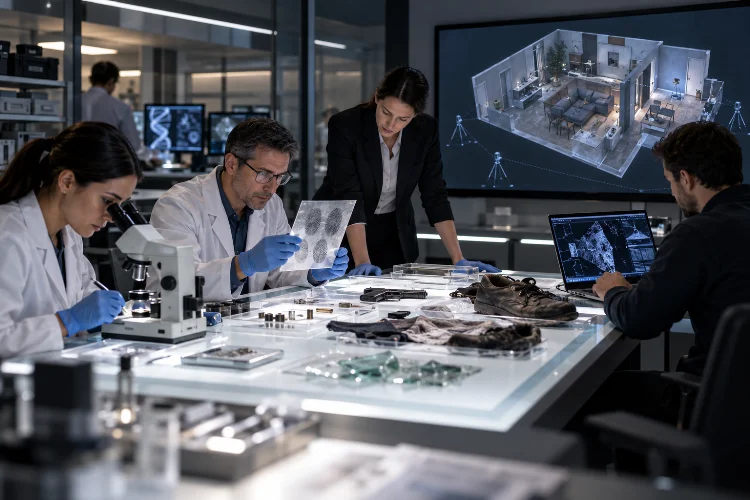
Instead of relying on one forensic specialty, investigators combine information from crime scene examination, DNA analysis, pathology, toxicology, trace evidence, bloodstain analysis, firearms examination, digital forensics, and other scientific disciplines.
Each field answers different questions.
DNA may help identify who contributed biological material. Pathology can provide information about injuries. Toxicology may identify substances that affected a person’s condition.
Digital evidence can establish communications or timestamps. Scene reconstruction connects those findings to physical space.
When the disciplines work together, investigators can move beyond collecting isolated clues and begin developing a scientifically supported explanation of what may have occurred.
Why Complex Criminal Events Need More Than One Forensic Discipline
Many crimes simply cannot be understood through one evidence category.
Imagine investigators are examining a suspicious death inside a residence. They discover biological stains, broken furniture, medication containers, a mobile phone, shoe impressions, and injuries on the deceased.
DNA testing might reveal whose biological material appears on different objects.
But DNA alone may not explain how those people interacted.
A forensic pathologist may examine the injuries and estimate their medical significance. Toxicology testing could determine whether alcohol, medications, or other substances were present.
Digital analysis might reveal messages, calls, photographs, location information, or device activity around the relevant time.
Meanwhile, scene investigators document where everything was found.
The reconstruction emerges from the relationship between those findings.
ANSI/ASB Standard 159, which covers foundational principles for scene investigation and reconstruction, emphasizes scientific reliability, preservation of context, evidence integrity, transparency, and bias management.
These principles are particularly important when several forensic disciplines contribute to one case.
The goal is not to make all evidence support the same story.
It is to determine whether independently obtained findings actually converge.
If they do not, the disagreement may be just as informative as the agreement.
Crime Scene Investigation Creates the Framework
Before specialized laboratory testing begins, investigators need an accurate representation of the scene itself.
This is the foundation on which later reconstruction depends.
Crime scene personnel document locations, relationships, environmental conditions, visible damage, biological material, impressions, objects, and other potentially significant evidence.
Photographs, notes, diagrams, measurements, and increasingly three-dimensional documentation can preserve relationships that might disappear once the scene is released.
Spatial Context Changes the Meaning of Evidence
Consider a cartridge case.
Finding one inside a room is useful information.
Knowing that it was located beneath a table, 2.5 meters from a damaged wall, near a particular blood pattern, and beside a doorway provides far more context.
The same idea applies to almost every form of physical evidence.
A shoe impression near an entry point means something different from one beside a body. A broken object underneath biological material may contribute to sequencing. An item found inside a closed room may carry different implications from an identical item recovered from a public hallway.
Scene reconstruction standards therefore emphasize preserving context rather than treating evidence as disconnected laboratory samples.
Good reconstruction begins with a simple principle: location matters.
Once context is lost, it may be impossible to recover completely.
DNA Evidence Helps Identify People – but Not Entire Events
Few forensic technologies have transformed criminal investigation as dramatically as DNA profiling.
Modern methods can generate profiles from very small quantities of biological material, sometimes including trace amounts associated with skin cells.
That sensitivity gives investigators extraordinary opportunities.
It also introduces complexity.
NIST’s 2024 scientific foundation review on DNA mixture interpretation explains that mixed samples can be challenging when biological material comes from multiple people, contributors leave different amounts, DNA becomes degraded, contamination occurs, or the relevance of detected DNA is uncertain.
This distinction matters enormously during reconstruction.
Finding a person’s DNA on an object may support an association between that person and the item.
It does not automatically reveal when the material was deposited.
It also does not necessarily establish what activity produced it.
Identity-Level Questions and Activity-Level Questions
Suppose DNA from Person A is found on the handle of an object.
One question is whether the detected genetic profile is consistent with Person A.
A different question is how Person A’s DNA got there.
Did they directly handle the object?
Was biological material transferred indirectly through another person?
Had Person A touched the object days earlier?
Was the material deposited during the criminal event?
These are reconstruction questions rather than identification questions.
NIST’s review specifically discusses DNA transfer, persistence, contamination, relevance, likelihood ratios, and different levels of propositions used when evaluating forensic DNA evidence.
Multidisciplinary investigation becomes useful because other evidence may help answer the activity-level question.
Fingerprints, video, witness observations, scene location, trace evidence, or digital timestamps may provide context that DNA alone cannot.
DNA can be extremely powerful.
But like almost every forensic discipline, it becomes more informative when interpreted alongside other evidence.
Pathology and Toxicology Add a Biological Timeline
When an investigation involves death or serious injury, forensic pathology becomes a central part of reconstruction.
A forensic pathologist evaluates injuries and medical findings to help determine issues such as cause of death and the mechanisms associated with trauma.
But pathology does not operate in isolation.
The pathologist may need scene photographs, investigative information, medical history, toxicology findings, and other evidence before forming a complete opinion.
Imagine a deceased individual has several injuries.
The physical appearance of those injuries might suggest different mechanisms, but scene evidence can help establish what objects or surfaces were present.
Blood distribution may contribute information about movement.
Digital evidence might help establish when the person was last active.
Toxicology adds another layer.
Toxicology Can Explain Condition and Capability
Forensic toxicology examines drugs, alcohol, poisons, medications, and related substances in biological samples.
In reconstruction, the important question may not simply be whether a substance was detected.
Investigators may want to understand whether it could have affected consciousness, coordination, judgment, or another relevant physiological condition.
Forensic toxicology laboratories operate under standards addressing issues such as identification criteria, procedures, validation, measurement uncertainty, and reporting. NIST’s OSAC standards library includes numerous current standards covering these areas.
Interpretation still requires caution.
Detecting a drug does not automatically prove precisely how a person behaved.
Concentration, metabolism, tolerance, interactions between substances, sample type, postmortem changes, and medical circumstances may all matter.
This is why toxicological results are strongest when considered with pathology and scene information instead of being used as a stand-alone explanation.
Trace Evidence Can Connect People, Objects, and Places
Some of the most useful forensic evidence is incredibly small.
Fibers, fragments of glass, paint particles, soil, debris, hair, and other microscopic materials can move between people, environments, vehicles, and objects.
This is the world of trace evidence.
The basic idea is simple: physical contact may result in material transfer.
But interpreting that transfer is more complicated.
Suppose investigators find tiny glass fragments on a suspect’s clothing.
The fragments could become important if their physical and chemical properties are consistent with glass from a broken window at the crime scene.
But analysts still have to consider alternative sources, the prevalence of similar material, transfer mechanisms, persistence, contamination, and the timing of deposition.
NIST’s forensic standards library contains specialized methods and standards for materials such as glass and geological evidence, reflecting how highly technical trace comparison can become.
Trace Evidence Works Best as a Connection Tool
Trace evidence rarely acts like a video recording of an incident.
Its power often comes from linking elements of a case.
Material from Scene A may appear on Object B.
Fibers associated with Clothing C may appear in Vehicle D.
Soil on footwear may share characteristics with material collected from a particular location.
These associations can strengthen or challenge a reconstruction.
They can also reveal movement that investigators did not initially suspect.
However, analysts must resist treating similarity as absolute proof of a unique source unless the scientific method genuinely supports that conclusion.
The correct question is often not “Does this prove the suspect was there?”
A better question is “How strongly does this finding support one explanation compared with realistic alternatives?”
That shift makes the interpetation more scientifically defensible.
Bloodstain and Firearms Evidence Help Reconstruct Physical Actions
Some forensic disciplines focus heavily on physical events.
Bloodstain pattern analysis may help investigators evaluate the distribution and characteristics of blood deposits.
Firearms and shooting scene examination can involve cartridge cases, projectiles, impact damage, possible trajectories, firearm function, and other evidence.
These findings can contribute to questions about direction, movement, relative location, and event sequence.
For example, a reconstruction may compare the position of impact damage with scene geometry.
Bloodstain distribution may be examined alongside injuries and object locations.
A cartridge case may be evaluated relative to other scene evidence rather than being treated as a meaningful coordinate by itself.
In 2026, the AAFS Standards Board published ANSI/ASB Standard 196 covering the documentation and processing of shooting scenes that may later be subject to shooting reconstruction.
That distinction is useful.
Scene documentation and full reconstruction are related but not identical.
Investigators first preserve what exists.
Reconstruction comes later, when measurements and laboratory findings are integrated.
Different Evidence Types Can Challenge One Another
Suppose one proposed account says a person was standing in a particular position when a weapon was discharged.
Scene geometry might make that position possible.
But bloodstain evidence could suggest a different relative location.
Pathology findings may indicate a wound path inconsistent with the proposed orientation.
Digital video may show movement shortly before the event.
The purpose of multidisciplinary forensics is not to pick the evidence category investigators like best.
It is to reconcile the complete evidence set.
Sometimes this produces a stronger reconstruction.
Sometimes it demonstrates that the original theory cannot work.
Both outcomes are scientifically useful.
Digital Forensics Adds Time, Communication, and Behavior
Modern criminal events often leave two crime scenes.
One exists in physical space.
The other exists across phones, computers, cameras, cloud services, vehicles, and communication systems.
Digital evidence can add information that traditional physical evidence cannot easily provide.
Investigators may examine device activity, communications, files, application data, images, videos, metadata, or other digital artifacts depending on the legal authority and circumstances of the investigation.
NIST’s framework for digital and multimedia evidence was developed partly to harmonize scientific reasoning across digital evidence and other forensic disciplines.
It identifies common forensic processes and emphasizes systematic, coherent examination rather than treating digital analysis as something fundamentally disconnected from traditional forensic science.
Digital Evidence Can Anchor a Timeline
Consider a hypothetical homicide investigation.
Scene analysis suggests an event occurred sometime during the evening.
A mobile device records activity shortly after 8 p.m.
A security camera captures a vehicle at 8:14 p.m.
A messaging application shows a communication at 8:22 p.m.
Another device becomes inactive at 8:27 p.m.
These digital events can help narrow the timeline.
But they still require interpretation.
A message timestamp does not necessarily prove who physically held the phone.
Location data can have varying precision.
Device clocks may differ.
Applications may synchronize information in ways investigators need to understand.
Digital evidence can therefore provide powerful temporal structure, but it should still be compared with physical findings.
When digital and physical timelines align independently, the reconstruction becomes much stronger.
Multidisciplinary Reconstruction Works Like Hypothesis Testing
One of the best ways to avoid tunnel vision is to reconstruct events using competing hypotheses.
Instead of beginning with “Suspect X did this,” investigators can build several possible scenarios.
Each scenario should generate predictions.
If Scenario A occurred, where should certain evidence be found?
Would the injury pattern make sense?
Would the digital timeline fit?
Should DNA from a particular person be expected on specific objects?
Would the distribution of trace evidence be plausible?
Would toxicological findings change the expected behavior of someone involved?
Investigators can then compare those predictions with the actual evidence.
Convergence Is Stronger Than Repetition
Ten pieces of evidence do not necessarily equal ten independent confirmations.
For example, several DNA samples collected from nearby areas might all originate from the same deposition event.
Multiple photographs of one shoe impression are still documentation of the same evidence.
True multidisciplinary convergence is different.
It occurs when independent methods produce findings that are compatible with the same explanation.
Imagine a reconstruction in which pathology, digital timestamps, scene geometry, DNA, and trace evidence independently support a similar sequence.
That is generally more informative than multiple observations derived from one forensic mechanism.
The key word is independence.
When different evidence types rely on different scientific principles, agreement between them can provide powerful corroboration.
Managing Uncertainty, Bias, and Contradictions
No forensic reconstruction is perfect.
Measurements have uncertainty.
Evidence may be incomplete.
Some material may have been moved.
Certain timestamps may have limitations.
Biological samples may be mixtures.
Witnesses may remember events incorrectly.
Investigators therefore need to distinguish between strong conclusions and plausible possibilities.
ANSI/ASB Standard 159 explicitly includes transparency and bias management among the foundational principles of scene reconstruction.
That matters because multidisciplinary cases can create enormous amounts of contextual information.
A DNA analyst may hear what the pathologist thinks.
A trace examiner may know investigators already have a suspect.
A digital analyst may receive a detailed theory about what they are expected to find.
Some contextual information is necessary.
Some may unintentionally influence analysis.
Structured workflows, technical review, documented reasoning, and separation of observation from interpretation can help reduce that risk.
Contradictory Evidence Should Not Be Hidden
Complex investigations often contain inconvenient evidence.
That is normal.
Suppose five findings support a theory but a sixth reliable finding appears inconsistent.
Ignoring it would weaken the investigation.
The better approach is to determine whether the apparent contradiction results from measurement uncertainty, an incorrect assumption, unrelated background material, incomplete evidence, or a genuinely flawed reconstruction.
A good forensic model should be able to survive challenges.
If one contradiction collapses the entire theory, that may indicate the theory was never as strong as it appeared.
Turning Multiple Disciplines Into One Coherent Reconstruction
The final reconstruction should not simply be a pile of laboratory reports.
Investigators need to integrate findings into an understandable sequence while preserving the boundaries of each discipline.
A useful approach is to separate information into three layers.
First comes observation: what was actually documented or measured.
Second comes interpretation: what a particular forensic discipline concludes from that evidence.
Third comes reconstruction: how multiple interpretations relate to one another within a possible sequence of events.
Keeping these layers separate makes the logic easier to review.
It also prevents uncertainty from disappearing as information moves from one expert to another.
A DNA analyst might conclude that genetic evidence supports an association.
A pathologist may describe injuries as consistent with several mechanisms.
A digital examiner may establish a time range rather than an exact moment.
The reconstruction should preserve those limitations.
Turning “approximately,” “consistent with,” and “could have” into absolute statements can create false precision.
The strongest reconstruction is not necessarily the one with the most detail.
It is the one in which every important conclusion can be traced back to reliable evidence.
The Future of Multidisciplinary Forensic Reconstruction
Forensic reconstruction is becoming increasingly data-rich.
High-resolution scene scanning, improved DNA methods, advanced analytical instruments, digital extraction tools, statistical models, and automated data processing can provide investigators with more information than previous generations ever had.
But more data does not automatically mean better conclusions.
The future challenge will be integration.
Investigators need systems that allow different forensic specialties to communicate without blurring their scientific boundaries.
A toxicologist should not become a digital examiner.
A DNA analyst should not become a pathologist.
The goal is not to merge every discipline into one profession.
It is to create a reconstruction process in which specialists contribute reliable findings to a shared evidentiary model.
NIST’s work on harmonizing digital evidence with broader forensic science illustrates this direction toward common reasoning frameworks across specialties.
Standards development is moving in the same direction, with hundreds of forensic standards now tracked through the NIST OSAC Standards Library across disciplines ranging from toxicology and DNA to trace materials, digital evidence, scene investigation, and medicolegal death investigation.
Technology will continue to change.
The scientific requirement will remain the same: conclusions need to be transparent, testable, properly limited, and supported by evidence.
Reconstructing criminal events through multidisciplinary forensics is powerful because no single form of evidence is expected to explain everything.
Crime scene examination establishes physical context. DNA can help identify biological contributors. Pathology evaluates injuries. Toxicology provides information about substances in the body.
Trace evidence can connect people and places, while bloodstain, firearms, and digital evidence may add information about actions, movement, and timing.
The strongest reconstruction emerges when these independent disciplines converge without being forced into a predetermined narrative.
For investigators, forensic students, and criminal justice professionals, the key is to think beyond individual laboratory results. Study how evidence interacts, question contradictions, preserve uncertainty, and test alternative explanations.
That is how scattered clues can gradually become a defensible scientific account of an occurence.