
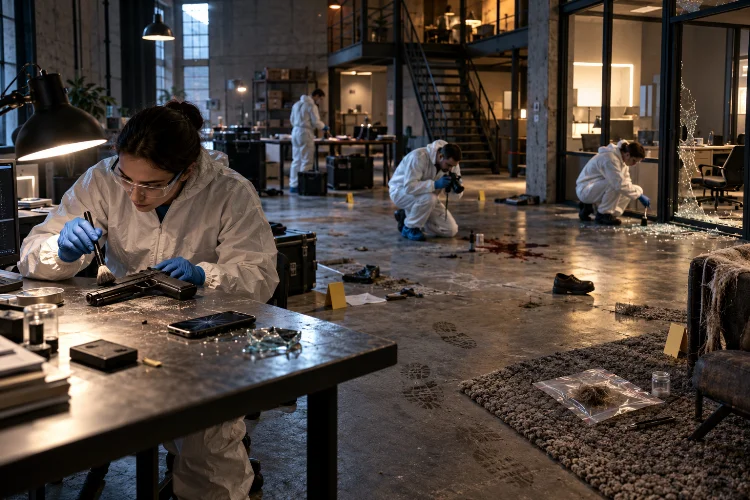
A complicated crime scene rarely comes with one perfect piece of evidence that explains everything.
Instead, investigators may face dozens – or hundreds – of items scattered across several rooms, vehicles, outdoor areas, or digital records.
There may be biological material, fingerprints, weapons, fibers, broken objects, bloodstains, footwear impressions, electronic devices, and trace materials, all potentially connected to different moments in the same event.
That is why evaluating physical evidence in complex crime scene investigations requires much more than collecting everything that looks suspicious.
Investigators need to determine what is relevant, how reliable the evidence is, whether it could have been contaminated or transferred, and how each finding relates to the wider scene.
According to the National Institute of Justice, crime scene investigators are responsible not only for locating forensic evidence but also for documenting the scene, taking measurements, collecting evidence, and maintaining its chain of custody.
The real challenge begins after collection.
Physical evidence becomes meaningful when investigators understand its context and carefully distinguish between what the evidence proves, what it suggests, and what remains uncertain.
What Counts as Physical Evidence at a Complex Crime Scene?
Physical evidence is essentially any material object or substance that may help investigators understand an event.
At a relatively simple scene, this might involve a handful of obvious items. At a complex scene, the variety can become overwhelming.
Investigators may encounter fingerprints, biological fluids, hair, fibers, footwear impressions, tire marks, glass fragments, paint, firearms evidence, documents, drugs, debris, damaged property, or electronic devices.
NIJ identifies fingerprints, footprints, tire tracks, blood, other body fluids, hair, fibers, and fire debris among the evidence commonly collected during crime scene examinations.
But simply finding an object does not automatically make it useful evidence.
Context matters.
A hair discovered on a sofa in a busy family home may have very different evidential value from a similar hair recovered from the inside of a sealed container connected to an investigation.
Likewise, a fingerprint on an exterior door handle might have many innocent explanations. The same type of impression found on an object that only the offender was expected to touch could carry much more investigative significance.
Evidence Value Depends on the Question
Investigators should constantly ask what question a particular item might help answer.
Does it help establish identity?
Does it show contact between people or objects?
Can it help reconstruct movement?
Does it support a timeline?
Could it indicate where an object originated?
Can it confirm or challenge a witness statement?
This way of thinking prevents crime scene teams from treating every piece of physical material as equally important.
Evidence is valuable because of its relationship to a specific investigative question.
Start With Context Before Jumping to Conclusions
One of the easiest mistakes in a complex investigation is interpreting evidence too quickly.
Imagine a broken drinking glass beside a body.
The immediate assumption might be that the glass was broken during a struggle. But that is only one possibility.
Perhaps it was already damaged before the incident. Maybe emergency personnel accidentally knocked it over. Perhaps it was broken during an unrelated event several hours earlier.
A strong investigator begins with observation.
The glass is broken. Its fragments have a particular distribution. Some pieces may contain biological or fingerprint evidence. Certain fragments may be underneath other objects while others are above them.
Those are observations.
The explanation of how and when the glass broke comes later.
This separation between fact and interpretation is especially important in complex scenes because investigators are exposed to huge amounts of contextual information.
NIST defines contextual bias as a tendency for case-specific knowledge to affect the impartial collection, perception, or interpretation of evidence.
Suppose investigators already strongly believe a particular suspect committed the crime.
Without careful controls, ambiguous evidence may gradually start being interpreted in ways that support that theory.
This does not necessarily involve dishonesty.
Cognitive bias can happen subconsciously.
The goal is therefore not to pretend investigators know nothing about a case. It is to control unnecessary contextual information and continuously test alternative explanations.
Preserve Evidence Integrity Before Analyzing Meaning
The best forensic laboratory in the world cannot fully repair evidence that was poorly collected, contaminated, mislabeled, or mixed with unrelated material.
That is why evidence integrity begins at the scene.
ANSI/ASB Standard 159 establishes foundational principles for scene investigation and reconstruction, including preservation of context, evidence integrity, scientific reliability, transparency, legal considerations, and management of bias.
These ideas sound procedural, but they have direct scientific consequences.
Imagine biological material from two locations being accidentally packaged together.
The laboratory might detect DNA from several individuals, but the resulting mixture could be much harder to interpret because investigators can no longer confidently separate the original sources.
Or imagine wet biological evidence being improperly stored.
Degradation or microbial growth might affect later testing.
Chain of Custody Is More Than Paperwork
Chain of custody is sometimes treated like boring administrative paperwork.
It is actually one of the foundations of evidence reliability.
NIST defines chain of custody as the chronological record of an item’s transfer, handling, and storage from collection through its final return or disposal.
That record helps answer simple but critical questions.
Who collected the item?
Where was it stored?
Who opened the package?
When was it transferred to the laboratory?
Was it returned to secure storage afterward?
If those questions cannot be answered, confidence in the evidence may suffer.
In major investigations involving hundreds of exhibits, careful evidence tracking becomes even more important because a simple labeling mistake can create confusion across multiple examinations.
Documentation therefore needs to be treated as part of forensic science itself, not something added afterward.
Evaluate Different Evidence Types on Their Own Terms
A common mistake is assuming all forensic evidence operates in the same way.
It does not.
DNA, fingerprints, trace materials, bloodstain patterns, footwear marks, firearms evidence, and digital records each have different strengths, limitations, and methods of interpretation.
DNA Can Be Powerful – and Complicated
DNA evidence is often viewed as the gold standard of forensic science.
In many situations, it is extremely powerful.
But modern DNA analysis has become sensitive enough to detect very small quantities of genetic material. That increased sensitivity creates new interpretive challenges.
NIST explains that DNA mixtures become more difficult to interpret when multiple people contributed biological material, when one contributor left only a tiny amount, or when the DNA has degraded.
Researchers also have to consider whether detected DNA is actually relevant to the crime.
A person’s genetic material being present on an object does not automatically prove when it was deposited or what activity caused it.
A person may have directly touched the object.
DNA might also be transferred indirectly through another person or surface.
The NIST scientific foundation review on DNA mixtures specifically highlights challenges involving the number of contributors, contamination, trace quantities, relevance, and the interpretation of complex profiles.
That makes scene context crucial.
Pattern and Impression Evidence Requires Careful Interpretation
Fingerprints, footwear impressions, bloodstain patterns, toolmarks, and other pattern-based evidence can provide important information.
But analysts still need to evaluate the quality of the material available.
A clear impression may preserve numerous features.
A partial, distorted, smeared, or poorly photographed impression may support much weaker conclusions.
Investigators should therefore avoid thinking in simple categories such as “match” and “no match.”
Evidence quality exists on a spectrum.
The same principle applies to trace evidence.
Finding fibers with characteristics similar to material from another location may support an association, but investigators still need to ask how common those fibers are, how easily they transfer, how long they might persist, and whether there are innocent explanations.
A scientifically responsible evaluation considers both what evidence supports and what it cannot establish.
Understand Transfer, Persistence, and Contamination
Physical evidence moves.
This sounds obvious, but it has major consequences.
Fibers can transfer between clothing and furniture. DNA can move from hands to objects. Glass particles can become embedded in clothing. Soil may transfer to footwear. Hair can remain on surfaces long after the person who shed it has left.
Investigators therefore need to think about three related questions: transfer, persistence, and recovery.
How could the material have arrived?
How long could it have remained there?
How likely was it to be recovered using the method employed?
These questions can completely change the meaning of an item.
Suppose fibers from a suspect’s jacket are discovered in a vehicle.
That finding might seem important.
But if the suspect regularly used the vehicle, the fibers may be completely expected.
If the suspect had never knowingly entered the vehicle, the same discovery may deserve much closer investigation.
Context changes evidential weight.
Contamination Is a Different Problem
Contamination occurs when material is introduced in a way that does not reflect the original event.
This can happen through investigators, medical personnel, witnesses, equipment, packaging, laboratory processes, or contact between evidence items.
Even highly sensitive technology creates a paradox here.
As detection methods become better at finding tiny amounts of material, they can also become better at detecting tiny amounts of contamination.
This is one reason proper protective equipment, clean collection tools, separate packaging, elimination samples where appropriate, and detailed documentation remain essential.
More sensitivity is useful only when investigators can trust where the detected material came from.
Build an Evidence Matrix Instead of a Single Story
Complex crime scenes are dangerous places for premature narratives.
Once investigators develop a convincing story, it becomes tempting to make every new piece of evidence fit inside it.
A stronger approach is to treat reconstruction as hypothesis testing.
Imagine three possible versions of an incident: Scenario A, Scenario B, and Scenario C.
Instead of asking, “What evidence proves Scenario A?”, investigators should ask what each scenario predicts.
Would blood be expected in a particular location?
Would a window likely show damage from one side rather than another?
Should trace material appear on specific clothing?
Would digital timestamps fit the proposed sequence?
Would the injuries be consistent with the movement being suggested?
Investigators can then compare those predictions with the actual scene.
Look for Convergence Between Independent Evidence
The most persuasive reconstructions often involve several independent evidence sources pointing in the same general direction.
A footwear impression might indicate movement through a hallway.
Bloodstain distribution may support movement along the same route.
Video footage might place an individual nearby during the relevant time.
DNA or fingerprint evidence might connect that person with an object recovered farther along the route.
None of these findings necessarily tells the complete story alone.
Together, they can become much more informative.
This is sometimes more important than finding one dramatic “smoking gun.”
Complex investigations are often solved through convergence.
But contradictions matter just as much.
If reliable evidence does not fit the working theory, investigators should not automatically dismiss it.
The contradiction may reveal that the theory is incomplete—or wrong.
Measure the Strength of Evidence Without Overclaiming
One of the hardest parts of forensic work is communicating evidential strength.
People naturally want simple answers.
Is it the suspect’s DNA?
Did this shoe make that impression?
Did this weapon produce the damage?
Did the person stand in this exact location?
Science often gives more complicated answers.
NIST’s work on evidential statistics emphasizes understanding uncertainty in forensic measurements and analytical techniques so that decision-makers can better understand the strengths and limitations of evidence.
This is particularly important when forensic evidence is presented to investigators, prosecutors, attorneys, judges, or juries.
An examiner should not communicate greater certainty than the science supports.
Numbers Need Context Too
Statistics can make evidence sound highly objective.
They are useful, but numbers still need interpretation.
Forensic DNA evidence, for example, may be evaluated statistically using approaches that compare how probable the evidence would be under competing propositions.
Complex DNA mixtures introduce additional complications such as low DNA quantity, degradation, allele sharing, dropout, and artifacts. NIST-associated guidance has discussed these challenges and the need for supportable statistical approaches.
The same principle applies across forensic disciplines.
A measurement without an uncertainty estimate may sound more exact than it really is.
An algorithmic score without information about validation may be misleading.
A probability without clearly defined assumptions can easily be misunderstood.
The objective is not maximum certainty.
It is accurate communication.
Manage Human Bias in High-Pressure Investigations
Complex crime scenes create perfect conditions for cognitive overload.
Investigators may work long hours while receiving witness accounts, suspect information, laboratory findings, surveillance footage, intelligence reports, and pressure from supervisors or the public.
All of that information can shape interpretation.
NIST has highlighted human factors as an important area in forensic science, particularly because scientifically irrelevant information can influence examiners and create contextual or confirmation bias.
The solution is not to remove human judgment entirely.
Human expertise is essential.
Instead, forensic systems can be designed to reduce unnecessary influences.
For example, an examiner may initially evaluate a fingerprint without knowing that another evidence type has already linked the suspect to the scene.
A DNA analyst might establish interpretation parameters before comparing an evidence profile with a suspect’s known reference sample.
Independent verification and technical review can provide additional safeguards.
Even simple practices such as documenting alternative explanations can help investigators avoid tunnel vision.
Bias management is therefore not about accusing forensic professionals of being biased people.
It is about recognising that human cognition has predictable limitations.
Reconstruct the Scene From Evidence, Not Assumptions
Once individual evidence items have been examined, investigators can begin integrating them into a broader reconstruction.
This is where scene geometry, biological findings, trace evidence, pattern evidence, pathology, digital information, and witness accounts can be evaluated together.
But reconstruction should never become storytelling disguised as science.
The foundational ANSI/ASB standard for scene investigation and reconstruction emphasizes scientific reliability, preservation of context, transparency, evidence integrity, and bias management.
A good reconstruction should make clear which elements are directly observed and which are inferred.
For example, investigators may be able to establish that a bloodstain exists at a particular position with a specific shape.
They may then infer a possible direction of travel.
A larger reconstruction may suggest where a person was located.
Each step introduces another level of interpetation.
Keeping those layers visible allows other investigators and reviewers to evaluate the logic.
It also means some questions may remain unanswered.
That is normal.
An honest conclusion such as “the evidence does not allow these two possibilities to be distinguished” can be scientifically stronger than a confident guess.
Quality Review Can Catch Problems Before Court
Complex cases benefit enormously from independent review.
A second qualified examiner may notice a mislabeled photograph, an unsupported assumption, overlooked evidence, or an alternative interpretation.
Technical review also creates accountability.
Another professional should be able to follow the documentation and understand how the examiner moved from evidence to conclusion.
This idea matters because forensic mistakes can have serious consequences.
NIJ’s examination of wrongful convictions involving forensic science highlighted lessons including the need for objective conclusions, reliable techniques, clear terminology, correction of underlying causes when errors occur, and testimony that does not extend beyond established scientific knowledge.
Those principles are particularly relevent in complicated cases, where a large amount of evidence can make weak assumptions difficult to notice.
Quality assurance is not a sign that investigators distrust each other.
It is how scientific systems become more dependable.
Evaluating physical evidence in complex crime scene investigations is ultimately about connecting science with context.
A fingerprint, DNA profile, fiber, bloodstain, broken object, or footwear impression may provide useful information, but none should automatically be treated as the entire story.
Investigators need to consider relevance, transfer, contamination, chain of custody, uncertainty, alternative explanations, and possible cognitive bias before drawing broader conclusions.
The strongest reconstructions are usually built when independent evidence sources converge while contradictions are examined instead of ignored.
Modern forensic technology can detect and measure more than ever before, but careful reasoning remains just as important as advanced equipment.
For forensic students and investigators, the next step is simple: study individual evidence types deeply, but always ask how each finding fits into the larger scene – and what other explanation could still fit the facts.