
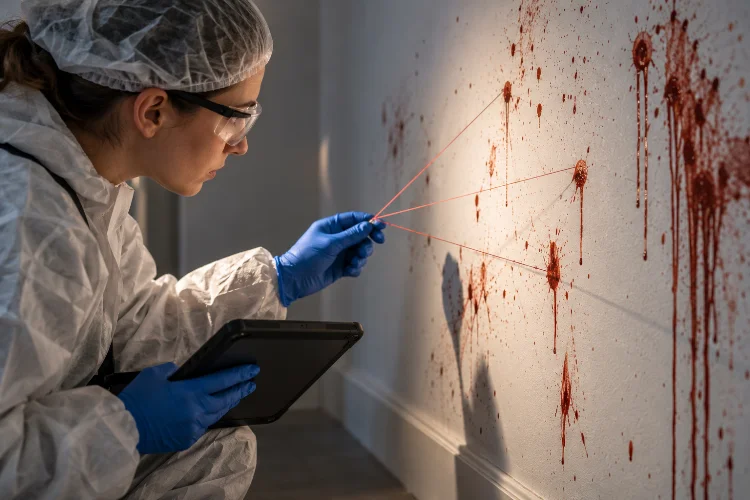
A bloodstain on a wall can look like little more than a dark mark to an untrained observer. To a forensic investigator, however, its shape, position, distribution, and relationship to nearby stains may contain clues about how an event unfolded.
That is the basic idea behind integrating bloodstain pattern analysis into crime reconstruction. Bloodstain pattern analysis, often shortened to BPA, examines the physical characteristics and distribution of bloodstains to evaluate possible events that produced them.
Crime reconstruction takes the process further by combining those observations with other evidence from the scene.
The important point is that blood patterns should not be treated as a magical replay button. They rarely tell the whole story on their own.
Instead, investigators compare bloodstain observations with scene geometry, injuries, trace evidence, damaged objects, witness accounts, digital evidence, and other forensic findings.
When these independent sources support one another, investigators can build a stronger reconstruction.
Done carefully, BPA can help answer questions about movement, position, sequence, and possible mechanisms. Done carelessly, it can create a story that sounds more certain than the evidence really allows.
What Bloodstain Pattern Analysis Actually Examines
Before discussing reconstruction, it helps to understand what a bloodstain pattern actually is.
NIST’s forensic science terminology describes a bloodstain pattern as a grouping or distribution of stains whose regular or repetitive arrangement provides information about how that pattern was deposited.
In simple terms, analysts are interested not just in individual drops but also in how multiple stains relate to one another.
An analyst may examine the size, shape, location, orientation, distribution, and physical characteristics of stains.
A nearly circular stain might suggest that a droplet struck a surface relatively straight on, while an elongated stain may be associated with a more angled impact. Groups of stains can provide additional information that a single mark cannot.
However, analysts have to consider the surface itself.
Blood landing on smooth tile may behave differently from blood landing on fabric, unfinished wood, carpet, or another irregular surface. Texture and absorbency can change stain boundaries and make interpretation more difficult.
This is why BPA is much more than simply looking at photographs and assigning familiar labels.
Observation Comes Before Interpretation
One of the healthiest habits in forensic analysis is separating observation from interpretation.
An observation might be: “There are several elongated stains oriented toward the northeast side of the wall.”
An interpretation goes further: “Those stains are consistent with droplets traveling in a particular direction.”
The distinction seems small, but it matters enormously.
When investigators jump directly to a theory, they may unconsciously describe evidence in a way that supports that theory. Recording measurable characteristics first creates a clearer line between what physically exists and what the analyst believes it could mean.
That separation becomes especially valuable when BPA is integrated into a larger crime scene reconstruction.
Why BPA Should Be Part of Reconstruction, Not the Entire Reconstruction
Crime reconstruction is broader than any single forensic discipline.
NIST defines scene reconstruction as a process for gaining knowledge about a series of events by combining physical evidence, scientific processes, deductive and inductive reasoning, and the relationships between them.
That definition explains exactly where bloodstain pattern analysis belongs.
BPA provides one stream of information.
Imagine investigators examining a room after a violent incident. They discover bloodstains on a wall, damaged furniture, broken glass, shoe impressions, biological material, and several objects that appear to have moved.
Studying the blood alone might suggest possible direction or movement. But investigators should compare that conclusion with everything else.
Does the blood pattern match the location of damaged objects?
Are the injuries consistent with the proposed event?
Do footwear impressions indicate movement through the same area?
Does DNA evidence establish who contributed particular biological material?
Do surveillance recordings or phone data support the proposed timeline?
If multiple independent forms of evidence point toward the same explanation, the reconstruction becomes stronger.
If they conflict, investigators need to understand why.
This is one reason crime reconstruction works best as a process of testing possibilities rather than proving the first theory that appears convincing.
Using Blood Patterns to Evaluate Movement and Position
One of the most useful contributions of bloodstain pattern analysis is helping investigators evaluate spatial relationships.
Blood does not simply appear randomly throughout a scene. Its distribution is influenced by forces, surfaces, movement, gravity, and other physical conditions.
Patterns may therefore provide information about where certain events could have occurred.
Direction and Angle of Impact
When an approximately spherical droplet hits a surface at an angle, the resulting stain may become elongated.
Under appropriate conditions, analysts can use the geometry of a stain to estimate an angle of impact.
This sounds straightforward, but real-world conditions complicate the calculation.
NIJ-funded research examining blood-droplet behavior found that traditional approaches can perform reasonably under some impact conditions while producing more significant errors at shallow angles.
Researchers also examined how factors such as surface roughness, wettability, and absorbency affect stain formation.
That means a calculated angle should not automatically be treated as a perfect measurement of what happened.
It is an estimate based on physical evidence and assumptions.
Area of Convergence and Area of Origin
When several directional stains belong to the same pattern, investigators may examine their trajectories together.
Two-dimensional analysis can sometimes identify an area where projected paths appear to converge.
A three-dimensional approach may go further by considering the possible location in space from which droplets originated.
This information can help investigators evaluate where a bleeding person or blood-producing event may have been located.
But again, the result is usually an area rather than a magical pinpoint coordinate.
Gravity, aerodynamic effects, stain selection, measurement error, and scene conditions all introduce uncertainty.
A responsible analyst therefore asks whether a reconstruction is consistent with the evidence rather than claiming that mathematics has recreated every movement with absolute precision.
Reconstructing the Sequence of Events
Crime scenes often contain evidence produced at different times.
That makes sequencing one of the most interesting—and difficult—parts of reconstruction.
Suppose investigators find several blood patterns on a floor, wall, and piece of furniture.
Some may have been created during an initial event. Others may have appeared when an injured person moved across the room. Additional stains might have been deposited when a bloody object contacted another surface.
The challenge is identifying which relationships can actually be supported.
Transfer and Contact Evidence
A transfer stain occurs when a blood-bearing surface comes into contact with another surface.
For example, a bloody hand touching a wall may leave a recognizable transfer pattern. An object moved after becoming stained can also produce contact evidence.
These marks can be especially useful when investigators compare them with scene geometry and other forensic evidence.
A transfer pattern near a doorway, for example, might be considered alongside fingerprints, footwear impressions, DNA results, and the location of other blood deposits.
The pattern alone may not establish exactly who moved through the doorway.
Together with other evidence, however, it can contribute to the event sequence.
Overlapping Patterns
Overlapping bloodstains may sometimes provide clues about deposition order.
If one stain clearly lies over another, investigators may attempt to determine which was deposited first.
But sequencing is not always easy.
NIJ-sponsored research evaluating current BPA methods found measurable error when analysts were asked to determine the deposition order of certain superimposed spatter and transfer patterns. The reported error varied depending on which type of pattern was deposited first.
That finding highlights an important rule for reconstruction: apparent sequence should be treated carefully when the visual evidence is ambiguous.
Not every overlap can be reliably placed into chronological order.
The Importance of Surface Type and Scene Context
A stain does not exist independently from the surface underneath it.
That surface can dramatically influence its appearance.
Smooth, non-absorbent surfaces often preserve stain boundaries differently from fabrics or porous materials. Clothing can stretch, fold, absorb liquid, and move while stains are being produced.
Those variables can complicate classification.
Research involving experienced analysts illustrates the problem.
In one NIJ-sponsored study involving bloodstain patterns on rigid non-absorbent surfaces, about 13 percent of classifications were erroneous under the experimental conditions. A related study using fabric surfaces reported an overall error rate of about 23 percent.
Those numbers should not be treated as universal casework error rates.
They came from controlled research designs with specific patterns, materials, and tasks.
Still, they offer an important practical insight: changing the substrate can change how easily analysts recognize a pattern.
Context Can Influence Interpretation
There is another complication.
Analysts are human.
The same studies examined whether contextual information could affect interpretation. When participants received misleading contextual information, erroneous classifications increased.
This phenomenon is sometimes discussed as contextual bias.
Imagine an analyst is told before examining the evidence that a suspect confessed to striking a victim repeatedly. That information might unintentionally influence how an ambiguous blood pattern is interpreted.
A better workflow controls contextual information wherever practical.
Analysts should receive information that is necessary for their examination while avoiding irrelevant details that might steer their conclusions.
This is particularly important when BPA becomes part of a bigger investigative theory.
The analyst’s job is to evaluate the physical evidence—not to make the evidence fit a preferred narrative.
What Reliability Research Tells Us About BPA
Bloodstain pattern analysis can provide valuable forensic information, but modern research has also highlighted limitations in accuracy and reproducibility.
Ignoring those limitations does not strengthen the discipline.
Understanding them does.
A large black-box study published in 2021 involved 75 practicing bloodstain pattern analysts and 192 bloodstain pattern images, producing more than 33,000 responses to prompts.
For samples with known causes, approximately 11.2 percent of responses were erroneous. About 7.8 percent of responses contradicted conclusions from other analysts.
NIJ’s summary of the research rounded these results to about 11 percent incorrect conclusions and roughly 8 percent contradictory conclusions between analysts.
Importantly, the researchers warned against treating these figures as universal operational error rates because the study conditions differed from normal casework.
That warning matters.
The research does not mean that 11 percent of all BPA conclusions in actual criminal cases are wrong.
It means that subjectivity and disagreement can occur, especially when patterns are difficult or terminology is inconsistent.
Terminology Matters More Than It Sounds
The study also found that some disagreement resulted from analysts using terminology differently.
At first glance, vocabulary might sound like a minor issue.
It is not.
If two experts use the same word to mean slightly different things—or different words for similar observations—their conclusions can appear inconsistent even before deeper scientific disagreement is considered.
Standardized forensic terminology helps reduce that problem.
NIST’s OSAC resources and Academy Standards Board publications include terminology, methodology, training, reporting, operating procedures, proficiency testing, and technical-review standards related to BPA.
The broader goal is straightforward: make the process more consistent, transparent, and reviewable.
A Better Workflow for Integrating BPA Into Crime Reconstruction
A strong reconstruction begins long before an analyst starts calculating angles.
The original scene needs to be preserved and documented properly.
That includes photography, measurements, notes, evidence identification, and documentation of the relationships between important objects and stains.
ANSI/ASB Standard 159 emphasizes principles such as scientific reliability, preservation of context, evidence integrity, transparency, and management of bias during scene investigation and reconstruction.
Once the scene has been documented, investigators can work from broad observations toward narrower interpretations.
Start With the Physical Scene
Before proposing a mechanism, analysts should understand where the stains are located.
A pattern on a ceiling has a different spatial relationship than one hidden behind furniture.
Nearby obstacles also matter.
A missing stain can sometimes be as interesting as a visible one if an object may have blocked droplets from reaching part of a surface.
Scene photographs, scaled diagrams, total-station measurements, photogrammetry, or 3D scanning can help preserve those relationships.
The goal is not to create the fanciest digital model possible.
The goal is accurate measurment.
Analyze Patterns Without Forcing a Story
The next stage involves examining the characteristics of relevant bloodstains.
Analysts should document what they can reliably observe, determine which stains appear related, and identify limitations.
Only then should possible mechanisms be evaluated.
Some evidence may support more than one explanation.
For example, a group of stains might be consistent with several possible mechanisms rather than one uniquely identifiable cause.
“Inconclusive” can therefore be a scientifically useful conclusion.
It is better than overstating what the evidence can support.
Combine BPA With Independent Evidence
After the blood evidence has been assessed, its conclusions can be compared with other forensic findings.
Medical findings may help assess whether injuries are consistent with a proposed event.
DNA analysis may help associate biological material with individuals.
Firearms examinations, trace evidence, fingerprints, digital evidence, and scene geometry can provide additional information.
Witness statements may also be considered, but physical evidence should not simply be reshaped to match testimony.
The reconstruction becomes most persuasive when independent evidence converges naturally.
Reporting BPA Without Overstating Certainty
The final stage of bloodstain pattern analysis is communication.
A scientifically careful examination can still create problems if its conclusions are reported with excessive certainty.
Reports should clearly distinguish observed evidence from interpretation.
They should describe important methods, relevant limitations, and the basis for conclusions.
ANSI/ASB Standard 158 provides guidance for developing bloodstain pattern analysis operating procedures, including requirements involving equipment, calculations, limitations, documentation, and reporting.
A separate 2025 standard establishes requirements for technical review of BPA reports containing results, interpretations, or opinions.
Technical review is especially valuable because another qualified person can examine whether the conclusions actually follow from the documented evidence.
This does not guarantee that every interpetation will be correct.
It creates another layer of quality control.
The same principle applies in court.
A visually impressive crime scene diagram or trajectory model can appear extremely convincing to a jury. Analysts therefore need to explain which elements represent direct measurements and which are estimates, assumptions, or illustrative reconstructions.
The goal should never be to produce the most dramatic version of an occurence.
It should be to communicate the evidence as accurately as possible.
Integrating bloodstain pattern analysis into crime reconstruction can give investigators valuable insight into movement, position, direction, and the possible sequence of events at a violent crime scene.
Its real strength, however, comes from integration rather than isolation. Blood patterns become much more informative when compared with scene geometry, medical findings, DNA evidence, trace materials, digital evidence, and other independent observations.
Modern reliability research also reminds us that BPA involves uncertainty, analyst judgment, surface effects, terminology issues, and the potential for contextual bias.
For forensic professionals and students, the best approach is therefore not to treat bloodstains as a perfect recording of the past. Treat them as one scientifically valuable part of a larger evidentiary puzzle – and keep testing whether the reconstruction really fits the evidence.