
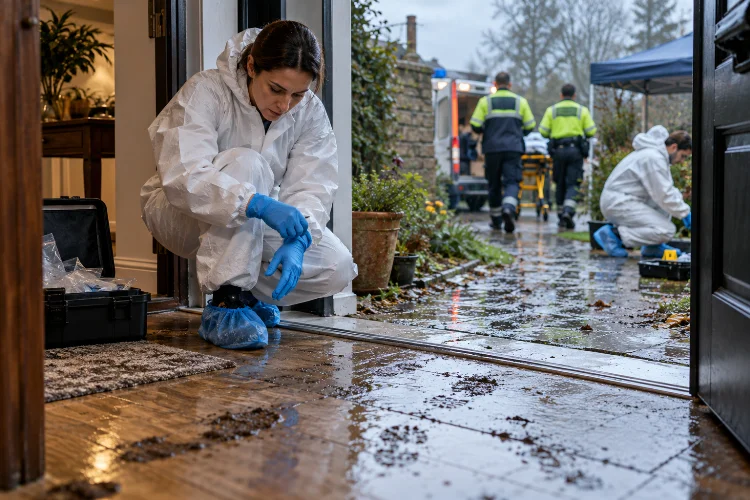
A crime scene can change long before a forensic scientist begins examining it.
Police officers may enter to provide emergency assistance. Paramedics move through the area. Witnesses may have touched objects before investigators arrive.
Rain, wind, heat, or animals can alter outdoor evidence. Later, investigators themselves can accidentally introduce material through gloves, footwear, tools, packaging, or repeated movement between different parts of the scene.
That is why assessing scene contamination risks in forensic reconstruction is such an important part of modern forensic work.
Contamination does not automatically make an entire scene useless. The real challenge is identifying what may have changed, documenting those changes, and determining how much confidence investigators should place in affected evidence.
Current crime scene standards emphasize preserving context, maintaining evidence integrity, controlling scene access, and managing contamination risks from the earliest stages of an investigation.
Forensic reconstruction therefore depends on more than finding evidence. Investigators must also ask a second question: Can we trust that this evidence still represents the original event?
Why Scene Contamination Matters in Forensic Reconstruction
Forensic reconstruction attempts to develop scientifically supported explanations of events using physical evidence and the relationships between different findings.
That process depends heavily on context.
If an item has been moved, a biological sample mixed with another source, or trace material accidentally transferred from one location to another, investigators may build conclusions around relationships that did not exist during the original event.
Consider a simple example.
An investigator enters Room A, collects several items, and then walks into Room B without changing shoe covers. Tiny particles from the first room could potentially move with that investigator.
If similar trace material is later recovered from Room B, investigators must consider whether it originated during the crime or during the investigation.
This distinction becomes particularly important when investigators are reconstructing movement.
A fiber, fragment, DNA profile, footwear mark, or blood-bearing item may appear to connect two locations. If that connection was created after law enforcement arrived, the reconstruction could become misleading.
ANSI/ASB Standard 159 establishes evidence integrity, preservation of context, transparency, scientific reliability, and bias management as foundational principles of scene investigation and reconstruction.
Contamination assessment is therefore not just a laboratory concern.
It is part of the logic behind the entire reconstruction.
Understanding Where Crime Scene Contamination Comes From
Contamination is often imagined as one careless investigator touching evidence with dirty gloves.
That certainly can happen, but real contamination pathways are much broader.
People, equipment, environmental conditions, emergency intervention, evidence packaging, and laboratory processing can all introduce unwanted material.
First Responders and Emergency Personnel
The earliest minutes of an investigation are often chaotic.
The priority may be saving a life rather than preserving a perfectly untouched scene.
Paramedics might cut clothing, move furniture, leave medical packaging, or reposition an injured person. Police officers may enter quickly to search for threats or additional victims.
These actions may be completely necessary.
The forensic problem comes later, when investigators need to distinguish changes made during emergency intervention from evidence created during the criminal event.
This is why documentation is so valuable.
Investigators should determine who entered the area, what emergency procedures were performed, what objects were moved, and which routes responders used whenever that information can be established.
AAFS Best Practice Recommendation 160 specifically addresses initial response issues including scene assessment, prevention of contamination, scene containment, evidence preservation, and documentation.
The goal is not to prevent necessary intervention.
It is to preserve enough information to understand its effects.
Investigators Can Become Transfer Vectors
Every person entering a crime scene can potentially carry material in and out.
Hair, fibers, skin cells, soil, dust, biological material, and microscopic particles can move through ordinary contact.
Tools create similar risks.
A measuring device, camera accessory, flashlight, forceps, or other equipment used in one area can potentially transport material to another if appropriate controls are not followed.
Even gloves are not automatically protective if they are used incorrectly.
A clean pair of gloves can prevent direct contact. But gloves that touch one piece of evidence and then another can become a vehicle for cross-contamination.
NIJ guidance emphasizes established entry and exit points, appropriate personal protective equipment, scene control, and designated disposal areas for used gloves and other potentially contaminated materials.
The principle is straightforward: investigators need to think about themselves as possible components of the evidence-transfer system.
DNA Contamination and the Problem of Secondary Transfer
DNA evidence deserves special attention because modern forensic techniques can detect extremely small amounts of biological material.
That sensitivity is incredibly useful.
It also means investigators may detect DNA that has a complicated history.
A DNA profile appearing on an object does not automatically mean that the person directly touched it during the crime.
DNA can be transferred directly, indirectly, or through a chain of contacts.
Direct Contact Is Not the Only Explanation
Imagine Person A shakes hands with Person B.
Shortly afterward, Person B touches an object.
Depending on the circumstances, biological material originating from Person A could potentially be transferred through Person B onto that object.
This is generally discussed as indirect or secondary transfer.
Research reviews on forensic DNA transfer emphasize that transfer, persistence, prevalence, and recovery are influenced by numerous variables.
These include the type of contact, surfaces involved, environmental conditions, background DNA, individual shedding characteristics, and subsequent handling.
The implication for forensic reconstruction is important.
“Person A’s DNA was detected” and “Person A handled this object during the crime” are not necessarily equivalent conclusions.
The first may be supported by laboratory analysis.
The second involves an activity-level interpretation requiring additional context.
Secondary Transfer and Contamination Are Related but Different
These ideas are sometimes used interchangeably, but it helps to separate them.
Secondary DNA transfer may occur naturally before or during a criminal event. For example, one person may unknowingly transport another person’s biological material.
Contamination usually refers to material introduced in a way unrelated to the original event, particularly during subsequent investigation, handling, testing, or storage.
A major review of DNA transfer emphasizes that everyone interacting with forensic items should understand transfer possibilities after criminal activity because such handling can create contamination or loss of DNA.
That distinction becomes essential when reconstructing events.
Investigators need to ask not only whose DNA is present but also when and how it might reasonably have arrived.
Controlling Access Is the First Major Defense
Once emergency priorities are addressed, controlling the scene becomes one of the most effective ways to reduce additional contamination.
More people inside the scene usually means more opportunities for alteration.
An effective access-control system establishes boundaries, designated entry and exit points, and records of people who enter.
NIJ’s crime scene guidance warns that investigators who do not work methodically risk contaminating or losing evidence and recommends treating each investigation as though it may be the only opportunity to preserve and recover the material.
This is especially important at large scenes.
A small apartment may have one obvious route through the environment.
A homicide scene covering a house, driveway, yard, and vehicle creates a much more complicated contamination map.
Think in Clean and Dirty Zones
A useful practical concept is separating areas according to contamination risk.
Some zones may contain biological hazards or heavily disturbed evidence.
Others may serve as staging locations where clean equipment is prepared.
Investigators can plan movement to reduce unnecessary travel between these areas.
The exact setup depends on the scene, but the underlying reasoning remains the same.
Do not move randomly.
If investigators repeatedly cross between unrelated evidence areas, they increase the possibility of transporting material.
A scene log also helps later reconstruction.
If unexpected DNA, fingerprints, fibers, or other materials are discovered, investigators can review who had legitimate access and whether an innocent transfer pathway is plausible.
Documentation that seems routine during processing may become crucial months later.
Collection Methods Can Create – or Prevent – Cross-Contamination
Finding important evidence is only part of the job.
Investigators also need to collect it without changing its meaning.
NIJ guidance on crime scene and DNA evidence states that biological material requires special care to prevent cross-contamination from investigators or other specimens. It also recommends methodical collection and appropriate packaging to prevent contamination, loss, and harmful changes.
This means collection order matters.
Fragile material may need to be processed early.
Different evidence items may require separate tools, clean swabs, fresh gloves, or independent packaging.
Investigators should also avoid unnecessary handling.
Every additional contact creates another opportunity to deposit or remove material.
Separate Evidence Usually Needs Separate Packaging
Placing unrelated items together can destroy information about where material originally came from.
Imagine two pieces of clothing from different people placed inside the same package.
Fibers, hairs, biological material, and debris could move between them during transportation.
Later examination might detect genuine physical material—but its location would no longer reliably represent the original scene.
NIST’s Biological Evidence Preservation Handbook provides guidance covering collection-related handling, packaging, storage, tracking, transfer, and preservation of biological evidence to reduce contamination, degradation, destruction, and loss.
Packaging is therefore not just transportation.
It is part of maintaining evidential meaning.
Moist biological evidence introduces additional concerns because improper storage may contribute to degradation or other changes. Evidence handlers must use appropriate preservation practices rather than simply sealing everything in whatever container is available.
Small procedural decisions can have large consequences later.
Environmental Contamination Can Be Just as Important
Not every contamination source is human.
Outdoor crime scenes are exposed to uncontrolled environments.
Rain can redistribute biological material. Wind can move lightweight debris. Soil may be displaced through pedestrian or vehicle traffic. Insects and animals can interact with remains or biological material.
Temperature and humidity can affect evidence preservation.
Even indoor environments are not completely stable.
Ventilation systems, running water, fire suppression systems, cleaning chemicals, smoke, and structural damage may change conditions.
Investigators therefore need to document environmental factors as part of their initial scene assessment.
Suppose blood-like staining is found outdoors after heavy rain.
Its current distribution may not perfectly represent the original deposition pattern.
A reconstruction should acknowledge that possibility rather than assuming every visible stain remained exactly where it was created.
This is where good scene documetation becomes important.
Photographs, measurements, weather information when relevant, observations from first responders, and timestamps can help investigators distinguish original conditions from later changes.
Environmental effects do not necessarily make reconstruction impossible.
They change the level of confidence that should be attached to particular observations.
Evidence Contamination Can Continue After the Scene Is Released
One of the biggest misconceptions is that contamination control ends when the evidence leaves the scene.
It does not.
Evidence passes through transportation, storage facilities, examination rooms, forensic laboratories, court proceedings, and sometimes additional rounds of testing.
Every stage creates new handling opportunities.
The chain of custody identifies who possessed or handled evidence, but contamination prevention requires more than maintaining a record.
Storage conditions, package integrity, laboratory workflow, clean equipment, controls, and separation of samples may all matter.
NIST’s biological evidence guidance emphasizes appropriate handling, packaging, storage, tracking, and transportation as part of maintaining evidence integrity.
Laboratories also need contamination-control systems of their own.
ANSI/ASB Standard 136, published in 2026, establishes requirements for limiting, detecting, assessing the source of, and mitigating human DNA contamination in forensic PCR-based laboratory analysis.
That standard applies specifically to laboratory DNA work rather than general crime scene processing.
Still, it illustrates an important principle: contamination control is a continuous process.
Evidence does not become immune to alteration merely because it has entered a laboratory.
How Investigators Assess Suspected Contamination
Discovering a possible contamination event does not automatically mean all related evidence should be discarded.
The better response is structured assessment.
Investigators first need to identify what happened.
Which person, tool, package, surface, or environmental condition could have introduced material?
When did the event occur?
Which evidence items were potentially exposed?
Was the contamination limited to one object or could it have spread across several areas?
The investigation then moves toward evaluating possible consequences.
Build a Contamination Timeline
Timing is critical.
Suppose an investigator accidentally touches an object without changing gloves.
If the previous evidence item touched by those gloves is known, the possible transfer pathway may be relatively narrow.
But if the same gloves were used across numerous objects, the number of possible contamination pathways becomes much larger.
Scene logs, photographs, collection records, body-worn camera footage, packaging information, and investigator notes may help reconstruct these movements.
Ironically, investigators may sometimes need to reconstruct the investigation itself before confidently reconstructing the crime.
Compare Expected and Unexpected Findings
Unexpected evidence can also trigger a contamination review.
Imagine a DNA profile from a crime scene employee appears on evidence where that person’s biological material should not reasonably exist.
That result might suggest contamination.
Similarly, unusual fibers appearing across evidence collected by the same technician could justify reviewing collection tools and procedures.
This does not mean every unexpected result is contamination.
It means alternative explanations need to be examined.
The goal is not to protect the original theory.
It is to understand the evidence pathway.
Incorporating Contamination Risk Into the Final Reconstruction
Contamination analysis becomes most useful when it changes how investigators communicate their conclusions.
A reconstruction should not present potentially affected evidence with the same confidence as well-preserved, independently supported material.
Suppose investigators believe a suspect moved through three rooms.
DNA evidence supports the proposed route, but one section of the scene experienced uncontrolled access from emergency responders.
The reconstruction might rely more heavily on securely documented evidence from the other locations while treating findings from the disturbed area more cautiously.
This does not require hiding uncertain evidence.
It requires weighting it appropriately.
Independent Evidence Becomes Extremely Valuable
One of the best defenses against a misleading reconstruction is evidential convergence.
Suppose a trace material association could theoretically result from contamination.
If independently obtained surveillance footage, scene geometry, fingerprints, and digital evidence support the same movement, the overall reconstruction becomes less dependent on the questionable trace result.
The opposite is also true.
If the entire reconstruction relies on one tiny biological sample with a plausible contamination pathway, investigators should be much more cautious.
Strong forensic reconstruction is rarely about maximizing the number of clues supporting one narrative.
It is about evaluating how reliable and independent those clues really are.
Uncertainty Should Stay Visible
Investigators cannot always determine whether contamination occurred.
Sometimes records are incomplete.
A scene may have been heavily disturbed before law enforcement arrived.
An object could have been touched by numerous innocent people.
In these situations, an inconclusive assessment may be more scientifically responsible than forcing certainty.
The foundational reconstruction standard emphasizes transparency and evidence integrity for exactly this reason.
Acknowledging uncertainty does not weaken forensic science.
Pretending uncertainty does not exist does.
Building a Contamination-Aware Forensic Culture
Contamination control works best when it is treated as a routine mindset rather than an emergency response after something goes wrong.
Training should help investigators understand not only which procedures to follow but why those procedures matter.
Changing gloves, controlling access, separating packages, cleaning equipment, recording scene entry, and limiting unnecessary movement may look like small tasks.
Together, they protect the relationships that reconstruction depends on.
Modern forensic sensitivity makes this even more important.
As laboratories become capable of detecting smaller quantities of material, investigators gain access to potentially valuable evidence that earlier techniques might have missed.
But greater sensitivity also increases the importance of understanding background material, transfer, persistence, and contamintation.
A tiny DNA profile may be scientifically detectable while its relevance to the criminal event remains uncertain.
That is why scene personnel and laboratory scientists need to communicate.
The scene investigator understands how an item was recovered.
The laboratory analyst understands analytical limitations.
The reconstruction team needs both perspectives.
Forensic quality is strongest when these roles support one another rather than operating as seperate islands.
Assessing scene contamination risks in forensic reconstruction is ultimately about protecting the connection between evidence and the event investigators are trying to understand.
Contamination can come from first responders, investigators, tools, environmental conditions, packaging, transportation, storage, or laboratory processes. Secondary transfer adds another layer by showing that material – especially DNA – can sometimes reach an object indirectly.
The solution is not to assume every unexpected finding is contaminated. It is to document access, control evidence handling, evaluate realistic transfer pathways, preserve chain of custody, and communicate uncertainty when the origin of material cannot be established confidently.
For investigators and forensic students, contamination awareness should begin before the first sample is collected. The better you understand how evidence can move, the better you can judge what that evidence really says about an occurence.